×
Proposal — March 2026

Workforce Management & Rostering Platform

Full custom development of an AI-enhanced operational platform for the Malta Dockers Union — powered by RosterAI, with Zoho Invoice integration and Dakar payroll connectivity.

133k
Project Investment
148
Development Days
~6
Months Delivery
Scroll to explore
Overview

Executive Summary

A purpose-built, enterprise-grade web application designed to replace manual processes with an integrated digital system for the MDU's unique operational requirements.

SKIOS proposes the full custom development of the Malta Dockers Union Workforce Management & Rostering Platform — a bespoke web application that will serve as the MDU's central operational hub. The platform manages the complete lifecycle of workforce rostering: from order intake and crew assignment through shift execution, payroll export, and client billing.

It will enforce the MDU's union fairness rules (license number sequencing), handle complex crew composition requirements across both Freeport (scheduled) and Marsa (reactive) operations, and provide a self-service portal for over 600 dockworkers. The platform is powered by RosterAI — SKIOS's proprietary intelligent rostering engine — which optimises roster generation, predicts availability patterns, detects operational anomalies, and provides real-time smart insights to administrators.

The platform integrates with Zoho Invoice for automated job-based billing and with the Dakar payroll system for seamless pay-run exports, eliminating manual data re-entry and reducing the risk of financial errors.

By building a fully custom platform, the MDU gains complete IP ownership, the flexibility to evolve the system as union rules change, and a user experience designed specifically for dockworkers and port administrators. There is no vendor lock-in.

Who We Are

About SKIOS

A Malta-based enterprise technology consultancy delivering bespoke software development, systems integration, and managed services for regulated industries across Europe.

Our team brings deep expertise in building mission-critical systems where reliability, data integrity, and regulatory compliance are non-negotiable. We operate as an extension of our clients' teams — providing the technical depth of a specialist consultancy with the responsiveness and accountability of an in-house engineering function.

Enterprise Capabilities

Relevant Experience

Government Voucher Platform (Astimulus) — Purpose-built platform facilitating distribution of over €100 million in government vouchers across European public entities. Handles complex eligibility rules, multi-party reconciliation, and real-time fraud detection.

Financial Services Integration — Enterprise integration projects for Bank of Valletta, connecting core banking systems with digital channels through secure API gateways.

Regulatory & Public Sector Systems — Solutions for Malta Business Registry, Transport Malta, Housing Authority, and VisitMalta — all requiring strict data governance, audit trails, and multi-stakeholder access control.

Healthcare & Pharmacy Systems — Operational management platforms for Browns Pharmacy, handling inventory, scheduling, and compliance reporting across a multi-site network.

Security & Compliance Credentials

Requirements

Understanding of Requirements

Our interpretation of the MDU's current operational challenges and desired outcomes.

Current Challenges

Manual, Error-Prone Processes

Rostering managed through Excel and Microsoft Forms, leading to data entry errors, version conflicts, and inability to enforce fairness rules systematically.

Lack of Worker Transparency

600+ dockworkers have limited visibility into roster assignments, waitlist positions, and replacement opportunities. Communication relies on informal WhatsApp groups.

Complex Fairness Rules

License number sequencing for equitable work distribution is difficult to enforce manually, especially with availability constraints and multi-skill workers.

Dual Operating Models

Freeport follows a 14-day advance cycle; Marsa is reactive and vessel-driven. Current tooling cannot accommodate both effectively.

Disconnected Billing & Payroll

Shift data is manually transcribed into Zoho Invoice and Dakar payroll files, creating delays, reconciliation overhead, and financial error risk.

Scalability Constraints

The existing approach cannot scale for seasonal fluctuations, additional clients, or future regulatory requirements without significant manual overhead.

Solution

Platform Architecture

A modern, full-stack web application comprising three logical layers: responsive frontend, secure backend API, and an integration layer connecting to external systems.

Custom Web Application

Responsive, mobile-first web app with modern frontend framework and robust server-side backend, hosted on EU-based cloud infrastructure for data residency compliance.

Rostering Engine

Purpose-built scheduling engine with two modes: Freeport (14-day advance with crew templates and recurring patterns) and Marsa (reactive, same-day crew assembly triggered by vessel arrivals). Both enforce fairness and crew composition rules.

Fairness Algorithm

Implementation of license number sequencing considering rotation position, worker availability, required skills/certifications, and waitlist priority. All assignment decisions logged with full rationale for audit.

Self-Service Worker Portal

Mobile-first portal for 600+ workers: personal dashboard, availability management, replacement requests, push/email notifications, and historical shift log.

Admin Dashboard & Reporting

Real-time roster overview with drag-and-drop, crew manifest generation, utilisation reports, exception tracking, configurable exports (PDF/Excel), and role-based access control.

Zoho Invoice Integration

Automated invoice line creation per completed shift via Zoho Invoice API. Support for multiple billing rates, draft review workflows, reconciliation dashboard, and error handling with retry logic.

Dakar Payroll Export

Per-worker breakdown of regular hours, overtime, and premiums. Validation checks for anomalies, export in required format (CSV/XML), and full audit trail linking payroll lines to shift records.

Communications Layer

Transactional email for shift confirmations and alerts, in-app notification centre with read/unread tracking, configurable templates, and daily digest option to reduce notification fatigue.

Design Preview

Platform UX & Interface Design

Every screen is designed using the Maritime Operational Excellence design system — built for precision, durability, and high-contrast utility. Below is a preview of the key interfaces across admin desktop and worker mobile experiences.

Admin Desktop
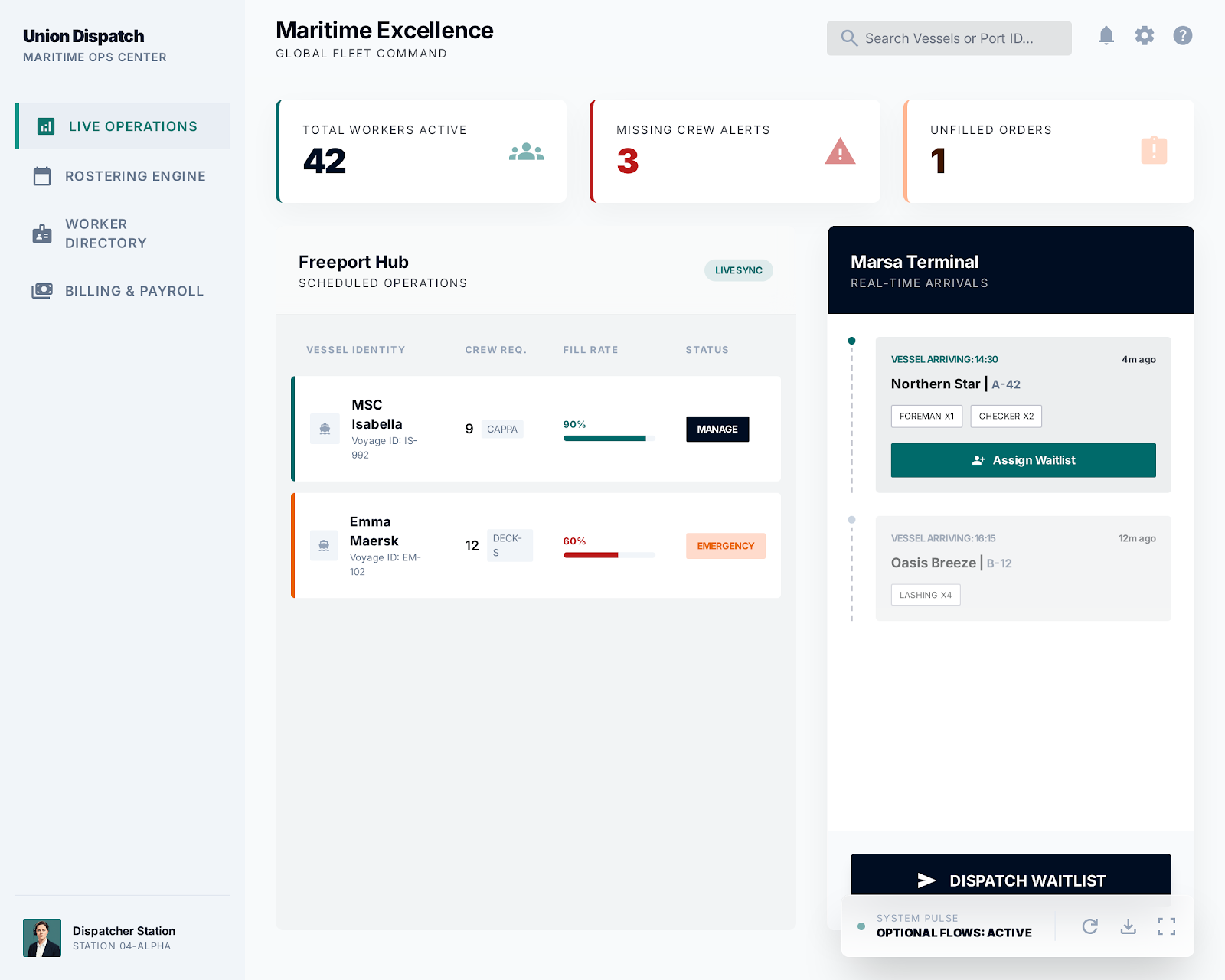
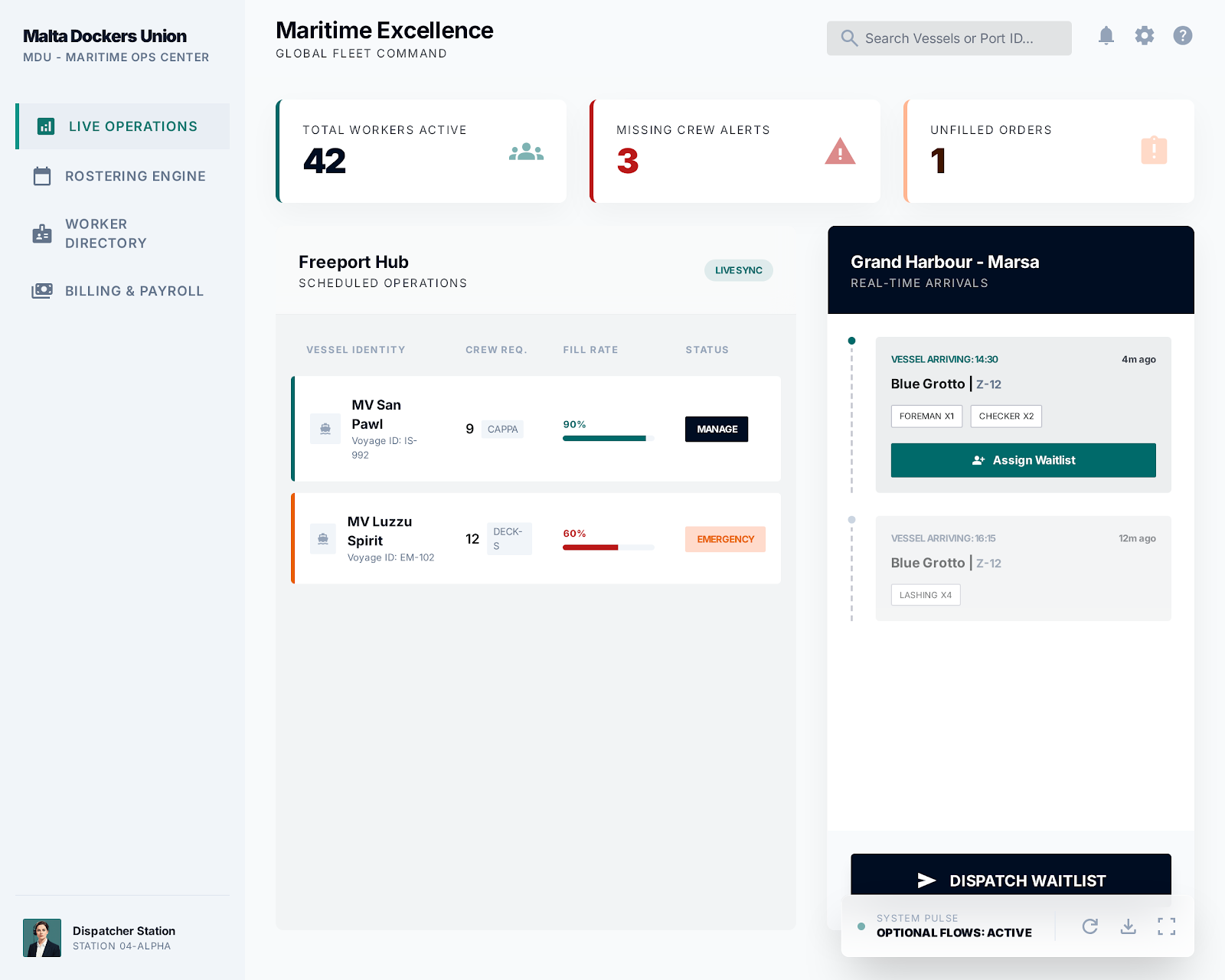
Operations Centre
Real-time operational dashboard showing live Freeport and Marsa operations, crew fill rates, vessel assignments, and dispatch controls.
Core Engine
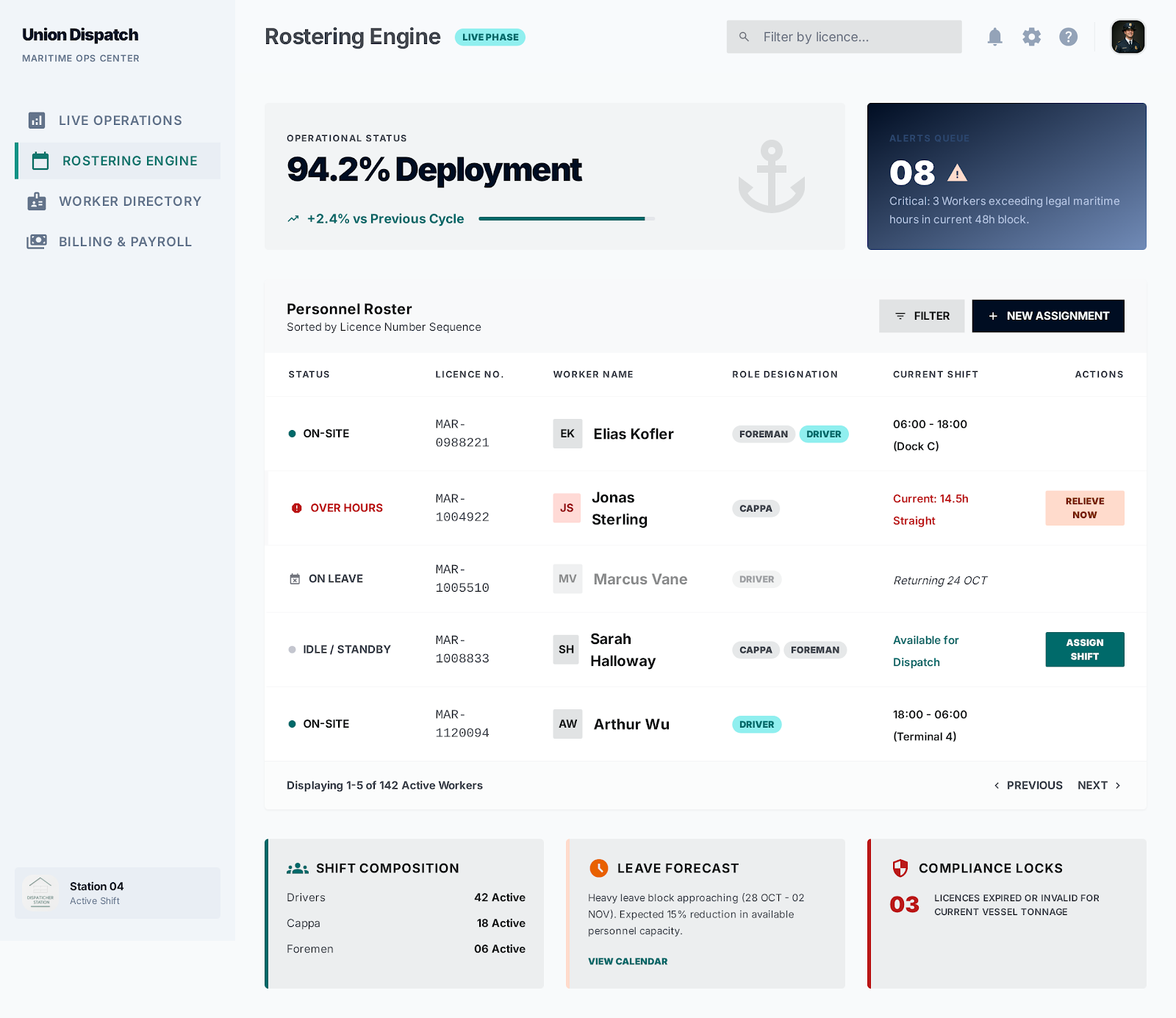
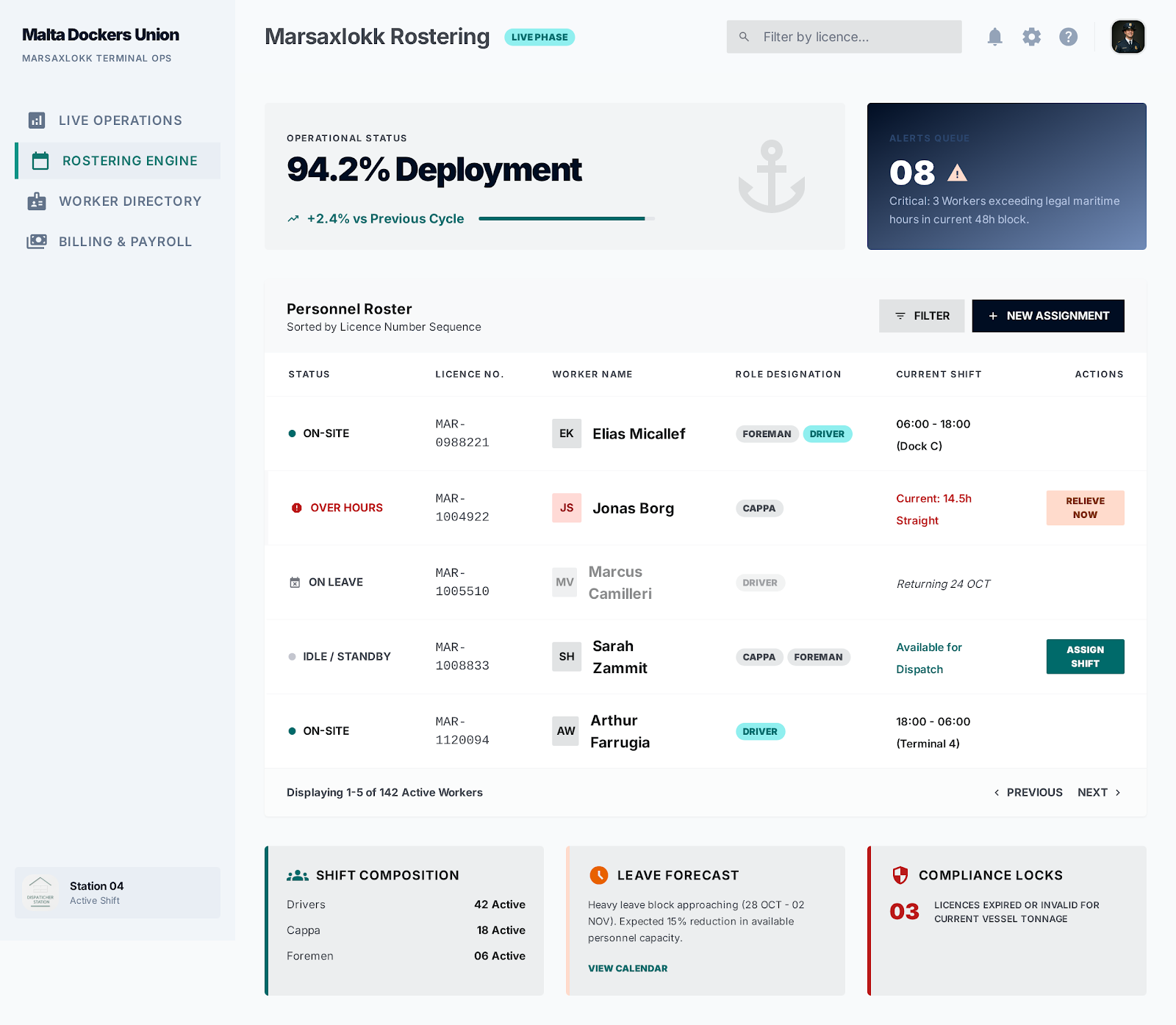
Rostering Engine
The rostering interface showing licence number sequencing, worker deployment status, shift composition breakdowns, leave forecasting, and compliance locks.
Administration
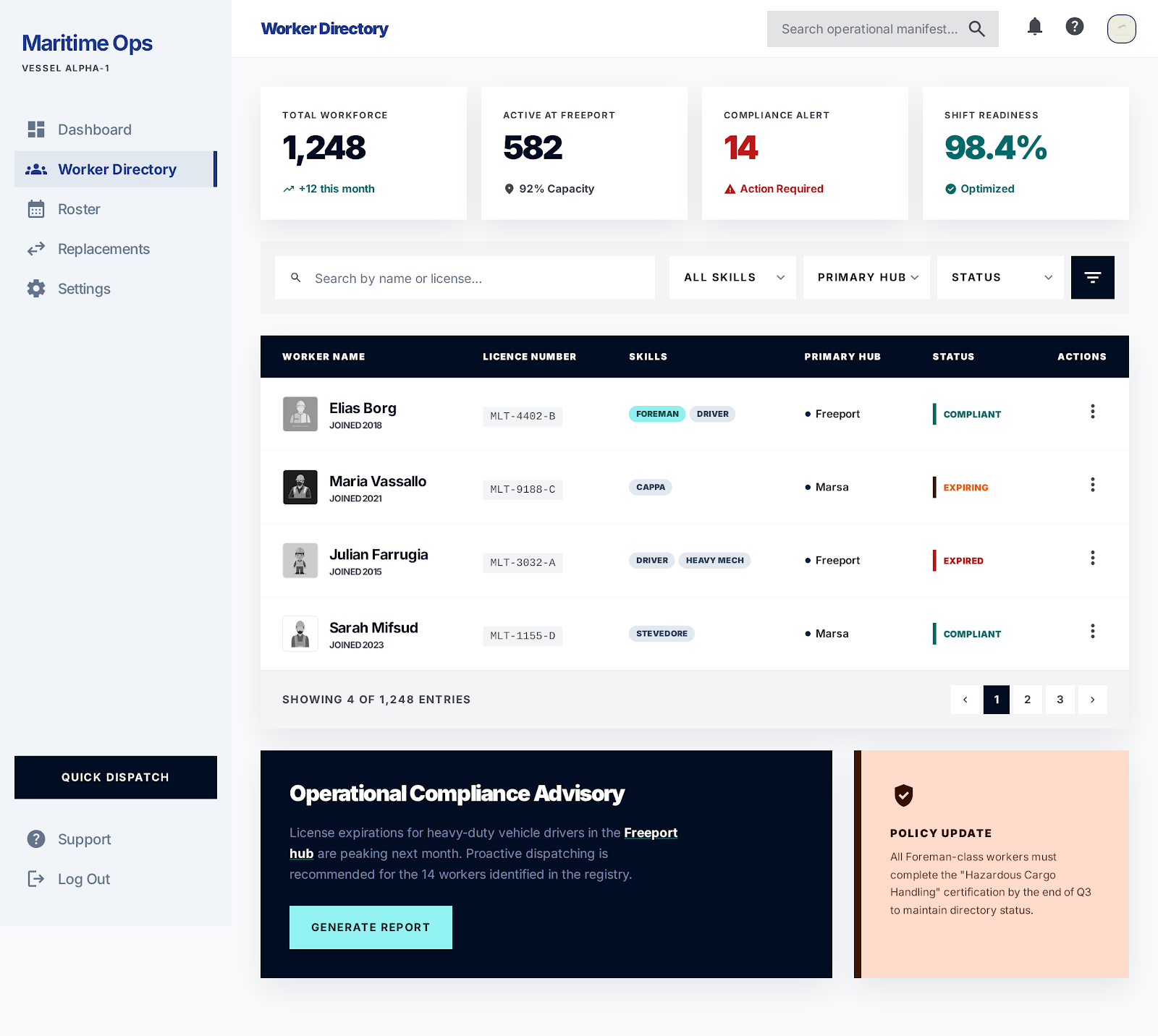
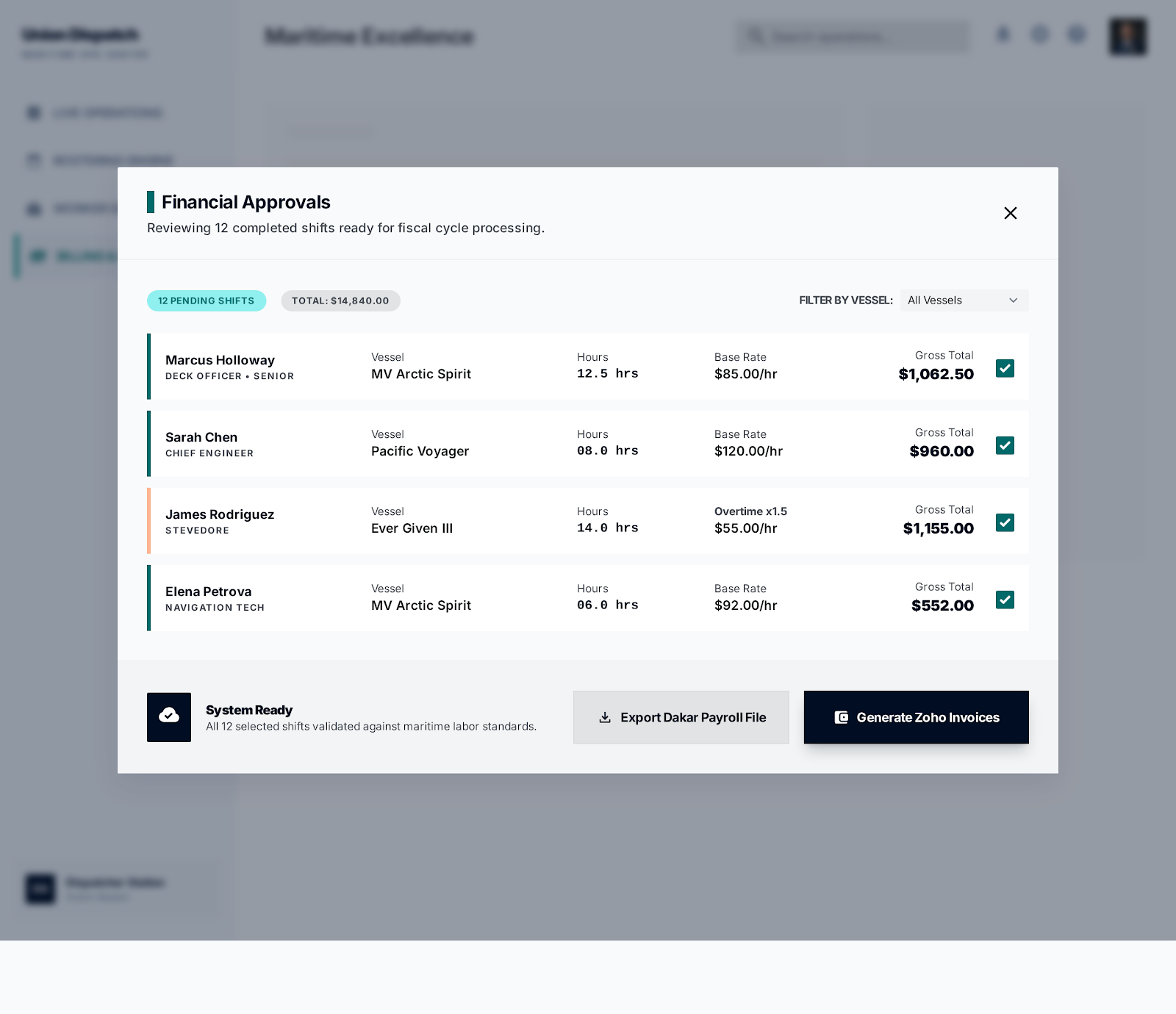
Worker Directory & Financial Approvals
Workforce registry with compliance tracking, skill filtering, and the financial approvals workflow for Zoho Invoice generation and Dakar payroll export.
Worker Portal
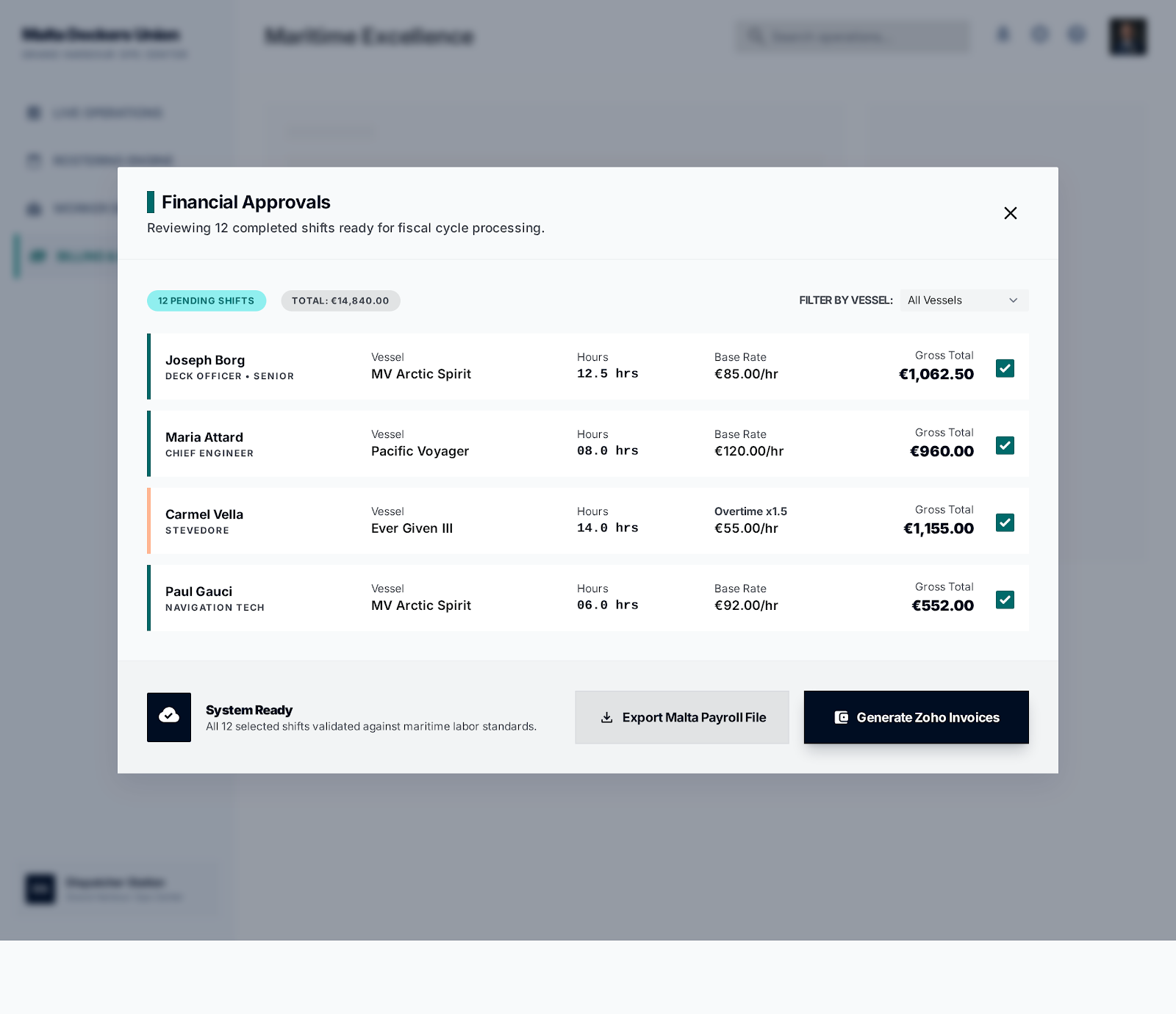
Self-Service Portal & Financial View
Desktop worker portal showing roster overview, shift details, and the worker-facing financial approvals screen.
Mobile Experience
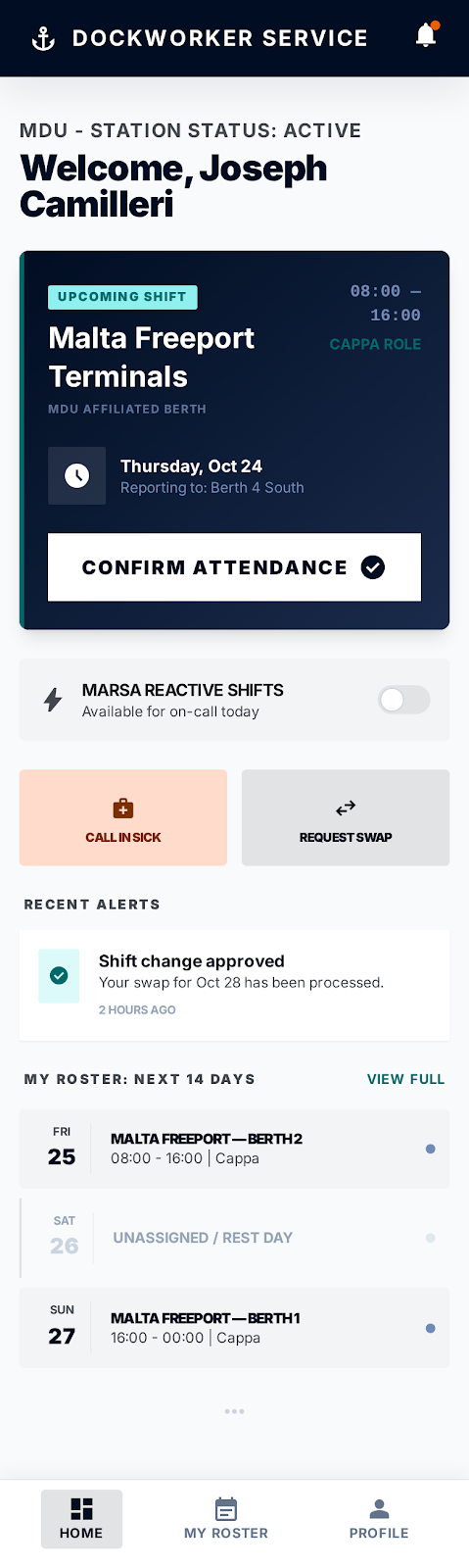
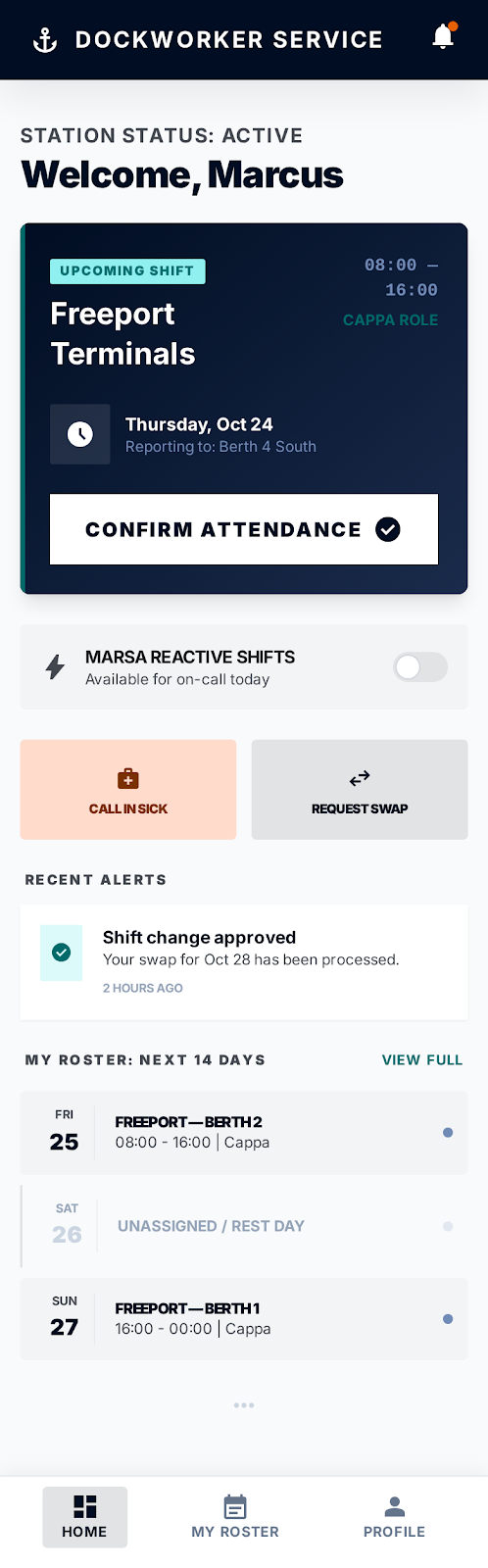
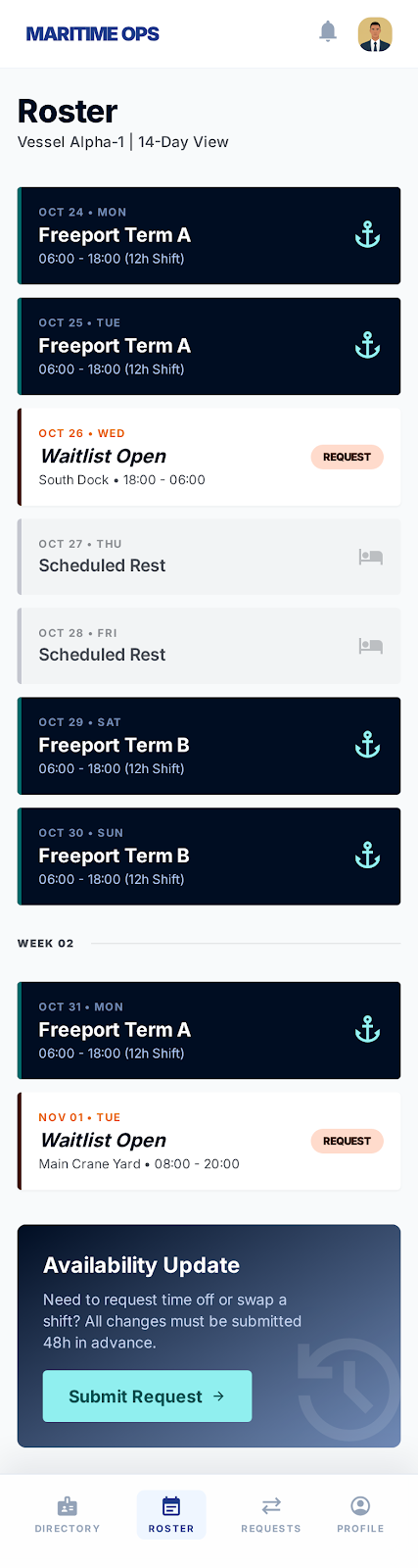
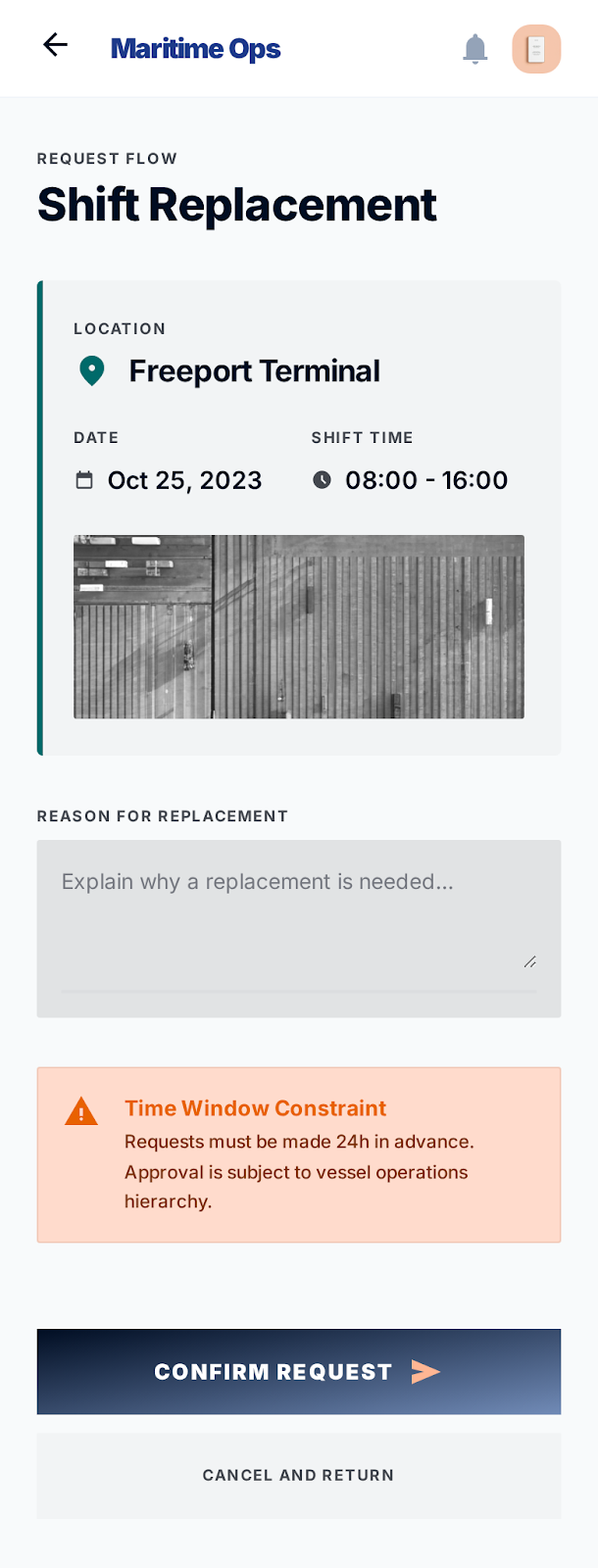
Dockworker Mobile App
Mobile-first interfaces designed for use on the port floor — high contrast, large tap targets, and glanceable information for dockworkers on the move.
Branding
Design System & Brand Identity
The Maritime Operational Excellence design system — precision-engineered for high-contrast utility, inspired by professional maritime instrumentation.

Colour Palette

Primary #000d22
Secondary #006a6a
Sec. Container #90efef
Tertiary #e86100
Surface #f8fafb
On Primary #718bb7

Typography

Inter
Neutral, technical clarity. Designed for glanceability under harsh conditions.
Display — 800 Headline — 600 Body — 400 LABEL — 700 CAPS

Design Principles

No-Line Rule — No 1px borders. Boundaries defined through background colour shifts only.

Status Beacons — 4px vertical strips replace status dots. Teal for active, orange for urgent.

Tonal Layering — Hierarchy through stacked surface tiers, not structural lines.

Industrial Radii — 0.25rem default, 0.125rem small. No rounded Material corners.

Component Patterns

PRIMARY ACTION
Command
SECONDARY
Support
URGENT ALERT
Safety
Status Beacons
Powered by

RosterAI

Intelligent Curator — AI-Forward Workforce Intelligence · skios.com.mt/products/roster-ai

AI-Enhanced Operations

The MDU platform will be powered by RosterAI — SKIOS's proprietary intelligent rostering engine. RosterAI transforms the platform from a digital process tool into a predictive operational system that continuously learns and optimises workforce deployment.

RosterAI brings enterprise-grade AI capabilities purpose-built for workforce management: real-time smart insights, conflict detection, AI-suggested shift swaps, auto-fill scheduling, and an operational pulse dashboard that gives administrators instant visibility into staffing health, optimisation potential, and pending actions — all designed around the "Intelligent Curator" philosophy of being authoritative, calm, and hyper-efficient.

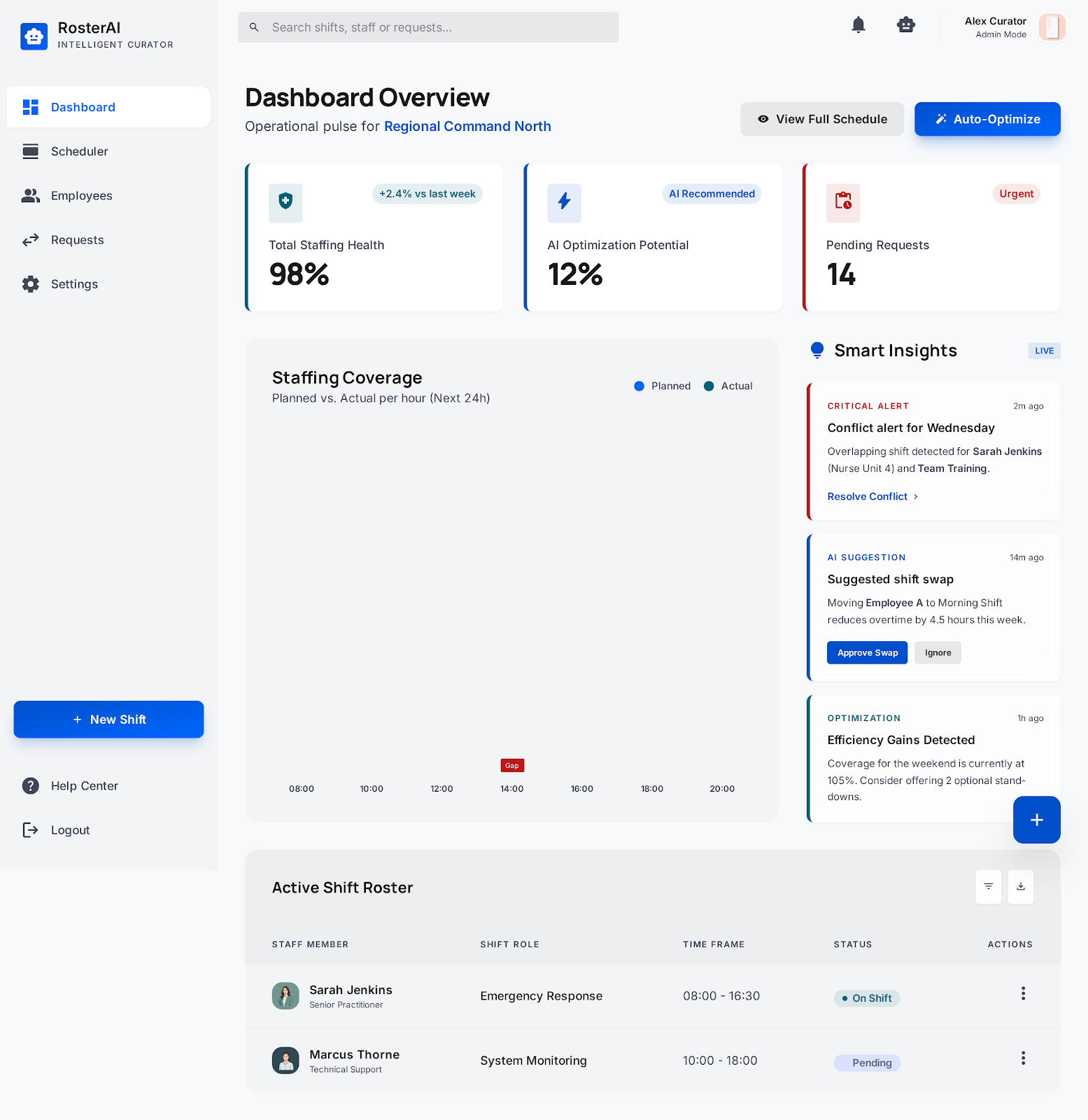
AI Dashboard & Smart Insights RosterAI

Real-time operational pulse showing staffing health, AI optimisation potential, and pending requests. Live Smart Insights feed surfaces critical alerts (conflict detection), AI-suggested shift swaps with one-click approval, and efficiency gain notifications. Auto-Optimize mode can rebalance the entire roster with a single command.

Intelligent Scheduler RosterAI

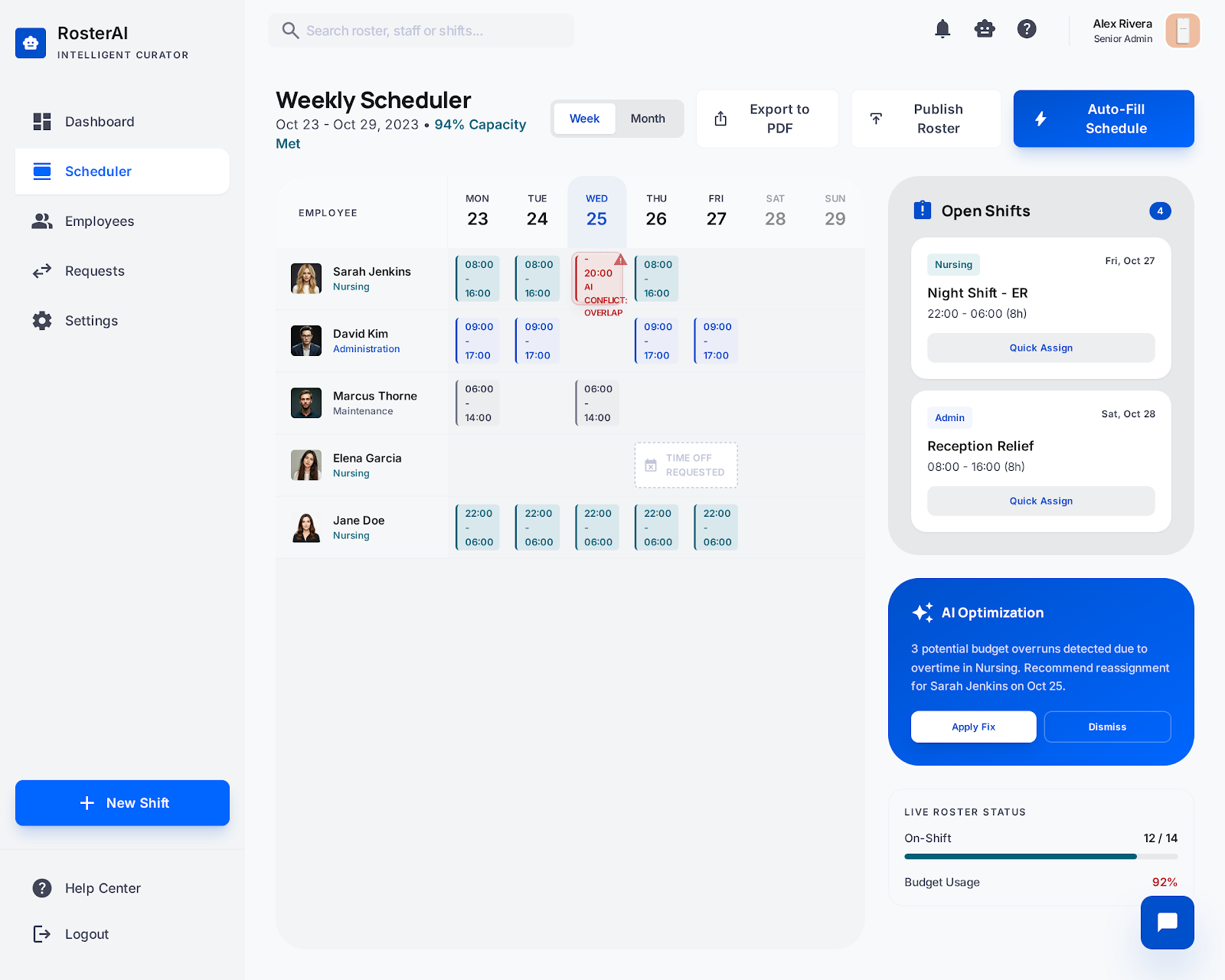
AI-powered Auto-Fill Schedule that generates optimal crew assignments considering fairness rules, skill requirements, availability, and historical patterns. Detects conflicts (overtime violations, shift overlaps) in real-time. Budget tracking and capacity monitoring with AI-suggested fixes when overruns are detected.

Predictive Analytics & Anomaly Detection RosterAI

ML models trained on operational data to forecast workforce demand, predict no-show probability, and identify seasonal patterns. Continuous anomaly monitoring flags unusual patterns: replacement request spikes, shift-type avoidance, billing discrepancies, or fairness distribution drift. Each alert includes context and recommended actions.

Swap Centre & Conflict Resolution RosterAI

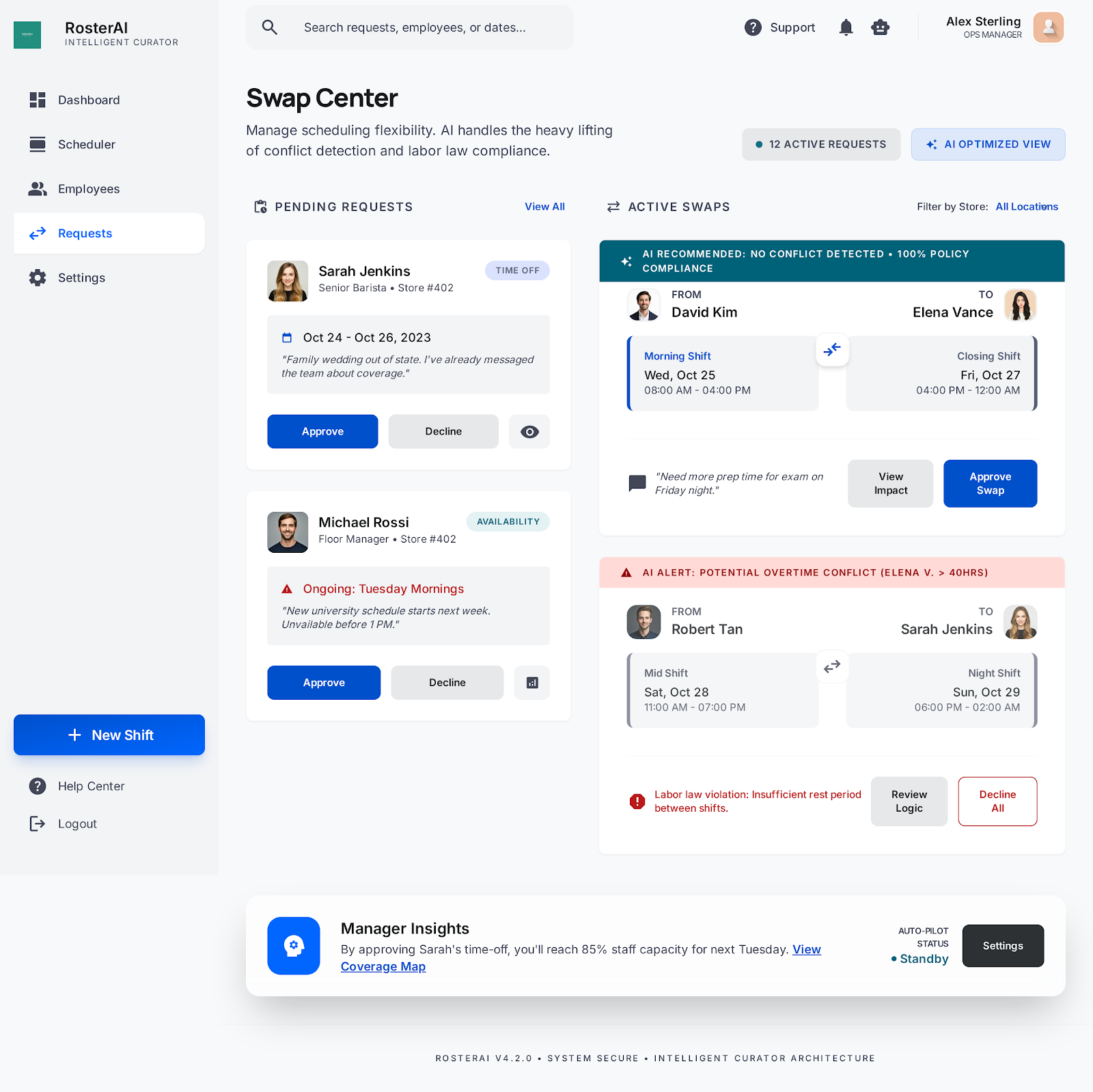
AI-validated shift swap centre with policy compliance checking. When a worker requests a swap, RosterAI evaluates labour law compliance, overtime implications, and skill coverage — recommending the best replacement with a "100% Policy Compliance" confidence badge. Manager Insights panel shows coverage impact and auto-pilot recommendations.

Skills Matrix & Workforce Intelligence RosterAI

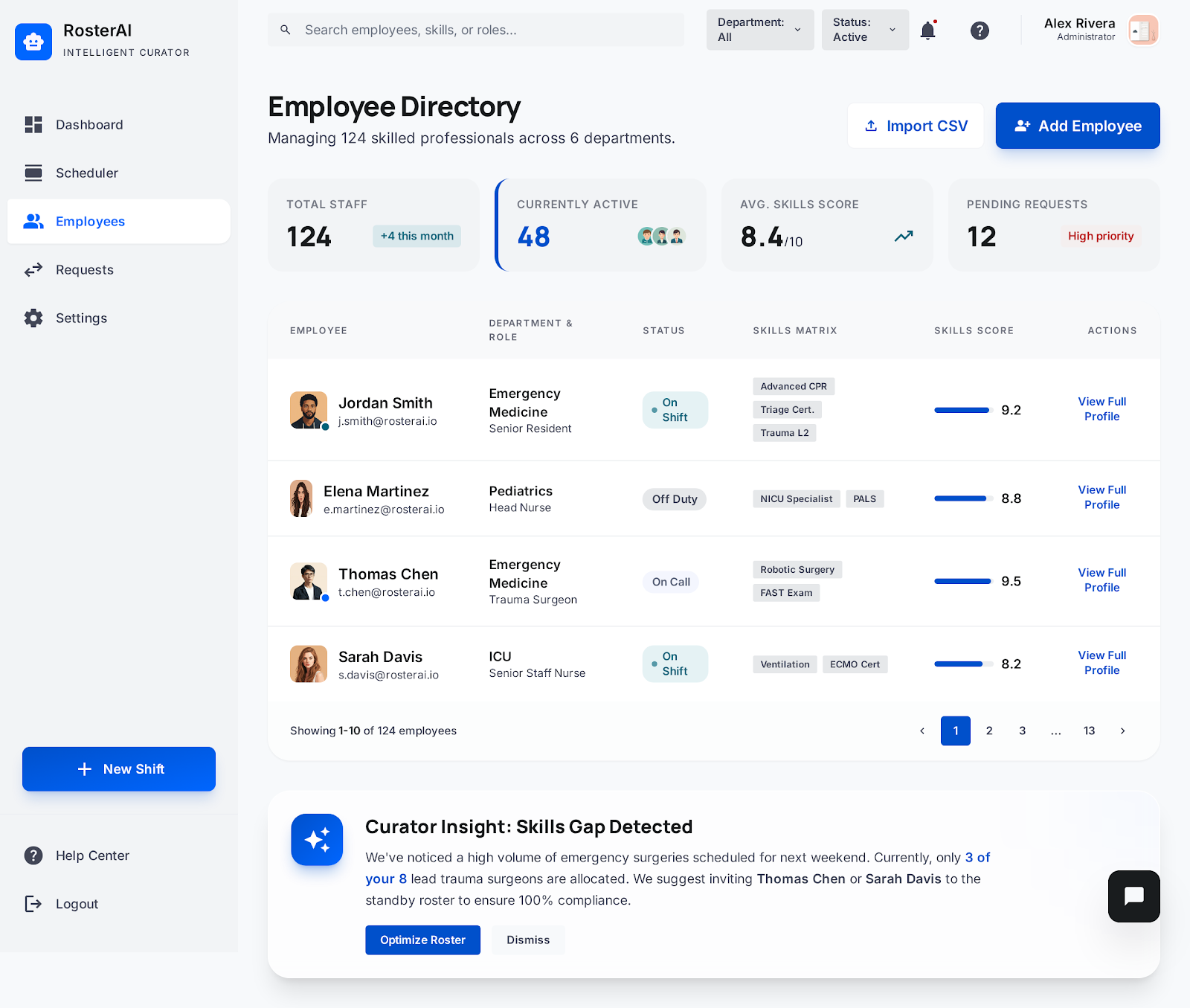
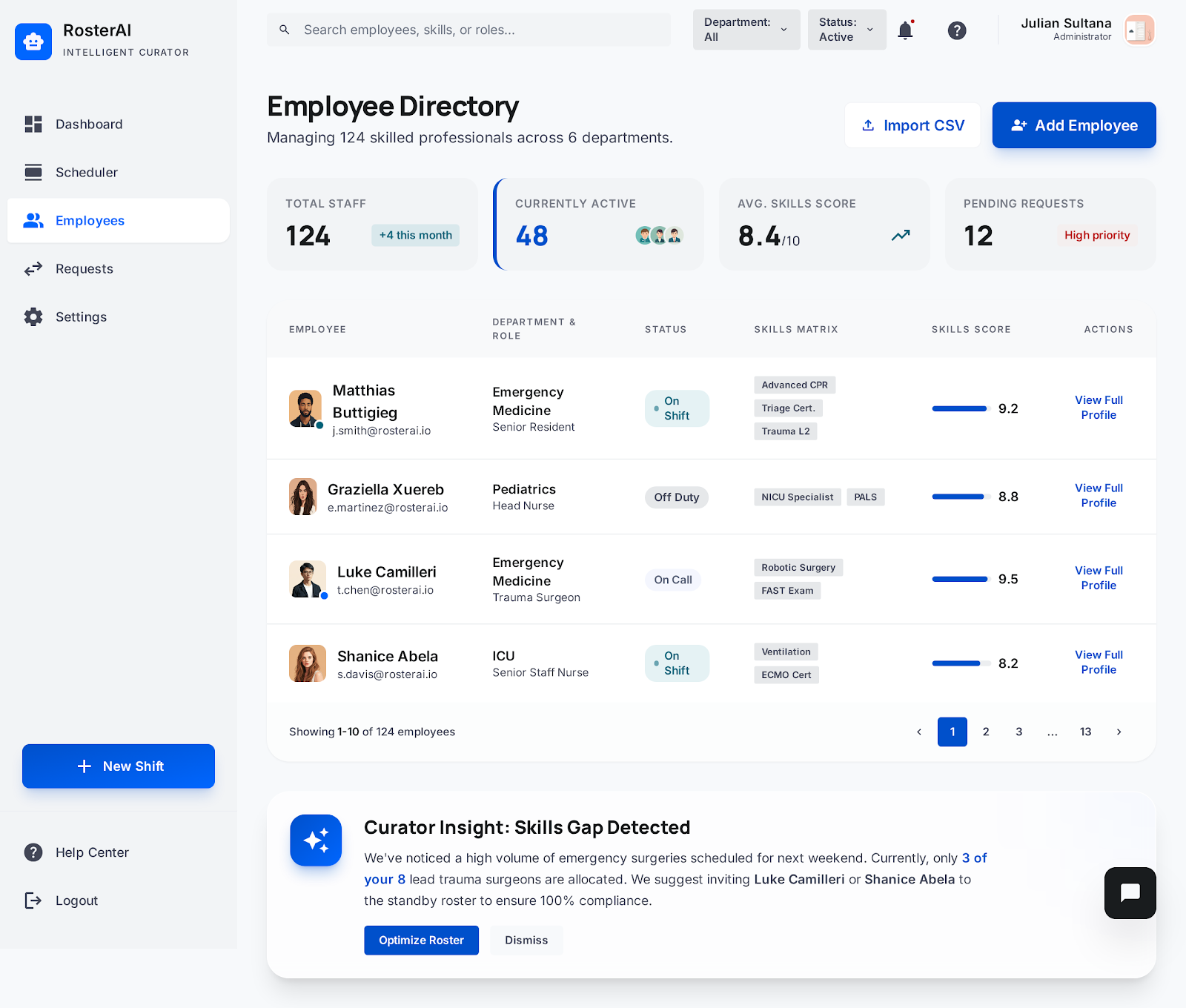
Centralised employee skills matrix with AI-powered gap analysis. The system identifies certification expiry risks, skill coverage gaps across shifts, and recommends training priorities. Integrated with the rostering engine to ensure only qualified workers are assigned to roles requiring specific certifications.

Natural Language Search RosterAI

Query the system in plain English: "show me all available Cappa-certified drivers for next Tuesday afternoon" or "which workers have exceeded 40 hours this week?" Smart notification prioritisation learns which channels and timing each worker responds to fastest, optimising communication delivery rates.

RosterAI is designed to augment human decision-making, not replace it. Every AI recommendation includes an explanation of its reasoning. Admins always retain full override authority. The system improves over time as it learns from the MDU's operational data. Learn more at skios.com.mt/products/roster-ai

RosterAI Interface Previews
Intelligent Curator — AI Dashboard & Scheduler
RosterAI's enterprise interface — real-time operational dashboards with Smart Insights, AI-powered weekly scheduler with auto-fill, and the shift swap centre with policy compliance validation.
Swap Centre, Skills Matrix & Employee Directory
AI-validated shift swaps with labour law compliance, centralised employee directory with skills matrix, and workforce intelligence for gap analysis.
Technical

Technical Approach

Enterprise-grade technology stack and engineering practices proven across regulated industries.

Technology Stack

LayerTechnologyRationale
FrontendReact / Next.jsComponent-based architecture, server-side rendering, mobile-first performance
Backend API.NET / Node.jsStrongly-typed, high-performance, excellent for complex business logic
DatabasePostgreSQLRobust relational DB for complex queries, audit logging, transactional integrity
AI/MLPython / scikit-learnIndustry-standard ML stack for predictive models and anomaly detection
AuthenticationOAuth 2.0 / OIDCIndustry-standard auth with MFA support, scalable to 600+ users
Email ServiceZeptoMail / SendGridHigh-volume transactional email with delivery tracking
HostingAzure / AWS (EU)EU data residency, managed services, auto-scaling, high availability
CI/CDGitHub ActionsAutomated build, test, and deployment pipelines
MonitoringApp Insights / SentryReal-time error tracking, performance monitoring, alerting

Security Architecture

Performance & Scalability

Development Methodology

Agile delivery adapted for enterprise engagements: a Discovery phase followed by iterative two-week sprints, each producing a demonstrable increment of working software.

Investment

Development Cost Breakdown

Blended rate of €900/day covering senior development, UX/UI design, AI engineering, and technical project management. Click each category to expand.

Core Platform Development

85 days
€76,500
Master Data & Worker Profiles
Registration, skill matrix, certifications, leave ledger, audit trail
12 days
€10,800
Rostering Engine
Freeport 14-day scheduling, Marsa reactive rostering, crew templates, shift lifecycle
26 days
€23,400
Fairness Algorithm
License number sequencing, availability/skill filtering, waitlist, rotation tracking
18 days
€16,200
Self-Service Worker Portal
Mobile-first UI, roster view, availability management, replacement requests, notifications
18 days
€16,200
Admin Dashboard & Reporting
Operational dashboards, crew manifests, utilisation reports, RBAC, audit trails
11 days
€9,900

AI & Intelligence Layer

18 days
€16,200
AI Roster Optimisation
ML model for crew compatibility scoring, reliability-weighted assignment, recommendation engine
8 days
€7,200
Predictive Analytics & Anomaly Detection
Demand forecasting, no-show prediction, availability pattern analysis, operational anomaly alerts
6 days
€5,400
Intelligent Automation
Smart notification prioritisation, auto-suggested replacements, natural language search
4 days
€3,600

Integrations

30 days
€27,000
Zoho Invoice Integration
API connection, job-based invoice generation, rate mapping, draft/approval workflow, reconciliation
13 days
€11,700
Dakar Payroll Export
Shift data structuring, overtime/premium calculation, export file generation, validation
10 days
€9,000
Communications Module
Transactional email, in-app notifications, template management, daily digest
7 days
€6,300

Delivery & Quality Assurance

15 days
€13,300
Testing & Quality Assurance
Unit tests, integration tests, UAT support, performance & security review
5 days
€4,500
Data Migration
Historical data import, cleansing, validation, verification
3 days
€2,700
Training & Documentation
Admin training, user guides, technical documentation, handover
3 days
€2,700
Project Management
Sprint planning, stakeholder communication, progress reporting
4 days
€3,400

Total Project Investment

148 development days
€133,000
Excl. VAT
Core Platform — 57%
AI & Intelligence — 12%
Integrations — 20%
Delivery & QA — 10%
Delivery

Project Timeline

Approximately 23 weeks (~6 months), structured into a Discovery phase, four development sprints, and UAT/Go-Live. Estimated start within Q2 2026.

Discovery & Design

Weeks 1–3
  • Requirements workshops
  • UX wireframes
  • Technical architecture
  • Data model
  • Integration specs

Sprint 1 — Foundation

Weeks 4–7
  • Master data module
  • Authentication & RBAC
  • Database & CI/CD
  • Dev/staging environments

Sprint 2 — Rostering Core + AI

Weeks 8–12
  • Rostering engine
  • Fairness algorithm
  • Crew composition
  • AI optimisation model
  • Anomaly detection

Sprint 3 — Portal & Intelligence

Weeks 13–16
  • Worker portal
  • Admin dashboard
  • Predictive analytics
  • Smart notifications
  • NL search

Sprint 4 — Integrations

Weeks 17–20
  • Zoho Invoice API
  • Dakar payroll
  • Billing reconciliation
  • E2E integration testing

UAT & Go-Live

Weeks 21–23
  • User acceptance testing
  • Data migration
  • Training
  • Production deploy
  • Hypercare
Clarification

Questions for Discussion

These highlight areas where the MDU's domain expertise is needed to inform design decisions. Click any question to expand.
Rostering & Fairness Logic
Q1License Number Sequence reset

How often does the fairness cycle reset? Daily? Weekly? Per job type? Different cycle for Freeport vs. Marsa?

Q2Seniority vs. sequence

Are seniority and license number sequencing the same thing, or can seniority override the license number order?

Q3Crew composition rules

What are the exact crew templates per job type? Is the list fixed or does it change per vessel/client?

Q4Partial crew handling

If the system cannot fill an entire crew, should it block the assignment or allow partial with a flag?

Q5Multi-skill workers

If a worker holds multiple certifications, how should they be prioritised across pools?

Shift Lifecycle & Replacement
Q6Replacement time windows

What are the actual hour thresholds for Freeport and Marsa replacement rules?

Q7Replacement matching

Must replacements follow the license sequence, or is it first-available from the waitlist?

Q8No-show policy

What happens when a worker doesn't show and no replacement was requested? Automated escalation?

Billing & Payroll
Q9Dakar integration format

What format does Dakar expect (CSV, XML, API)? One-way export or bidirectional sync?

Q10Billing rate structure

Who defines billing rates? Per-vessel, per-shift-type, per-client? How often do they change?

Q11Overtime/premium calculation

Time-based (after 8 hours), day-based (weekends/holidays), or both?

Q12Zoho Invoice setup

Does MDU already have a Zoho Invoice account? Existing templates or numbering conventions?

External Integrations
Q13Transport Malta

What APIs does Transport Malta expose? In scope or future? Should architecture accommodate it?

Q14Order intake

The 300 monthly Freeport orders — current format and desired intake method?

Q15Ship arrival data

Source for Marsa vessel arrivals: AIS feed, port authority API, or manual entry?

Users & Access
Q16Worker demographics

Smartphone usage percentage? Mobile-first mandatory or shared terminal access at port?

Q17Admin roles

Distinct roles (Roster Manager, Finance, HR, Super Admin) or all equal? Per-role permissions?

Q18Client portal access

Do clients like Freeport need portal access for order submission and crew manifest viewing?

Communications
Q19Email volume

250k/month (~400/worker) seems high. What generates this? Can notifications be consolidated?

Q20WhatsApp migration

Integrate with WhatsApp or replace entirely with in-app notifications?

Q21Language

English, Maltese, or both? Does the portal need to be bilingual?

Data, Compliance & Commercial
Q22Historical data

How much historical data to migrate? Is clean data available?

Q23Existing systems

Beyond Excel and Forms, any other systems in use?

Q24Regulatory constraints

Working Time Directive, mandatory rest periods — hard-coded system constraints needed?

Q25Audit reports

Specific reports for regulators or union governance board?

Q26Hosting preferences

Cloud provider preference (AWS, Azure)? On-premises? Data residency beyond EU?

Q27Go-live deadline

Target date or external deadline driving the timeline?

Q28Phased delivery

Phased go-live acceptable, or must all modules launch simultaneously?

Notes

Assumptions & Notes

Key assumptions underpinning the scope and pricing of this proposal.
  1. Fixed-Scope Project — The €133,000 investment covers all design, development, testing, deployment, and initial training as described in this proposal.

  2. Full IP Ownership — The MDU will own the complete source code, documentation, and all intellectual property upon project completion. No vendor lock-in.

  3. Zoho Invoice Licensing — Integration assumes standard Zoho Invoice API. Licensing/subscription costs are the MDU's responsibility and not included.

  4. Blended Rate — The €900/day rate covers senior development, UX/UI design, AI engineering, QA, and project management. It does not represent a single resource.

  5. AI Model Training — AI features use the MDU's operational data for model training. Prediction accuracy improves over time as the system accumulates historical patterns.

  6. Data Migration — The 3-day allocation assumes reasonably clean source data. Significant cleansing or transformation may require a change request.

  7. Infrastructure Costs — Cloud hosting, databases, SSL, domain, and email service subscriptions are operational expenses borne by the MDU, not included in the project cost.

  8. Third-Party Fees — Costs for third-party access fees (e.g., Transport Malta API, SMS gateway) are not included and will be quoted separately if added.

  9. VAT — All costs are exclusive of VAT, applied at the applicable rate.

  10. Change Management — Material scope changes managed through a formal change request process with written approval from both parties.